
This soup has a bit of an Advent feel — it’s something quick, made with what’s on hand and what you know you won’t use otherwise. For example, I didn’t end up using the sweet potato for a salad. I originally bought it with soup in mind, but I also had leftover kaffir lime leaves and yuba.
Ingredients:
- 100 g dried yuba
- 1 large onion (~100 g)
- 1 medium sweet potato (~300 g)
- 1 can of kidney beans
- 1 can of diced tomatoes
- 1 liter of broth (see notes)
- 40 g oil
- A handful of kaffir lime leaves
- 50 g light miso
- 40 g oil
Preparation:
- Soak the yuba in hot water and set it aside to cool. Cut it into ~3 cm pieces.
- Slice the onion into thin strips and dice the sweet potato. Drain the kidney beans (save the aquafaba for making mayonnaise if you like).
- Heat oil in a pan, then sauté the onion and yuba for 5–10 minutes, until the onion starts to brown.
- Add a teaspoon of cremo balsamico, mix well, and sauté on very low heat for another 5 minutes.
- Meanwhile, add the miso and sweet potato to the broth and cook until the sweet potatoes are tender.
- Add the canned tomatoes, kidney beans, and the onion-yuba mixture to the broth. Bring to a boil, add the kaffir lime leaves, and remove from heat. Season with salt if needed.
Variations:
This soup is flexible — add whatever you have on hand. I happened to have yuba, miso, and kaffir lime leaves, but tofu or cilantro would also work.
If you have an open can of coconut milk, oat milk, or soy milk, you can use it to make the soup creamier.
Miso adds umami and protein, but it’s not essential. You can use more tomatoes, soy sauce, or even Marmite for umami.
Notes:
A proper homemade broth simmered for hours is ideal, but if you don’t have one, a good-quality powdered broth will do. In a pinch, you can even use water, possibly with a splash of apple juice.
Serving:
Serve with bread, toast, a dollop of salted yogurt, or something spicy.
About Yuba
Yuba is a byproduct of tofu production, often underrated. It’s the “skin” that forms on the surface of soy milk during tofu production, which is carefully skimmed off and dried.
Yuba comes in various forms, but it’s always a relatively thin sheet. Sometimes it’s rolled up in different ways. It’s excellent as a chicken substitute in many dishes. In Asia, steamed yuba is molded into plant-based “drumsticks” and other products that mimic poultry.
One downside of yuba is its impermeable, uniform texture, which makes it harder to marinate or absorb flavors.
Kaffir Lime Leaves
If you’re marinating tofu with vinegar and seaweed for a fish-like or “oceanic” flavor, consider adding kaffir lime leaves to the mix.
Miso
Miso is a fermented soybean paste, a staple of Japanese cuisine, and the supposed source of samurai strength. While I can’t speak for the samurai, miso is an excellent addition to soups, marinades, and sauces, packed with umami.
Where to Buy:
You can find all three ingredients in Asian stores, on Allegro, or on Amazon. I don’t recommend fancy chain stores like “World Flavors.” Instead, shop at stores run by and frequented by Asians for the best price-to-quality ratio and authenticity.
Authenticity doesn’t necessarily mean the product is made in Asia — it could be produced in Hamburg. As long as the recipe, production methods, and ingredients are traditional, it doesn’t matter whether it’s made in Hamburg or Hong Kong.
For example, on a recent trip to a store in Harburg (a district in Hamburg), I bought wonderful, soft, artisanal tofu proudly labeled “Tofu from Hamburg.”
Asian Shops in Hamburg
These shops are among my favorite places, even back when I lived in Warsaw, Poland. In Warsaw, I was lucky to live just two bus stops or a 15–20 minute walk from such a store. Now I have to travel dozens of kilometers to get to Harburg, an industrial area west of Hamburg annexed by Nazi authorities in the 1930s as part of Greater Hamburg.
I recommend searching for these stores on Google Maps — they’re surprisingly easy to find. Look not only for Asian stores but also Arab or African ones. In Hamburg’s St. George district, I recently discovered a whole street filled with such stores and eateries serving authentic cuisine not for tourists but for locals.
About St. George
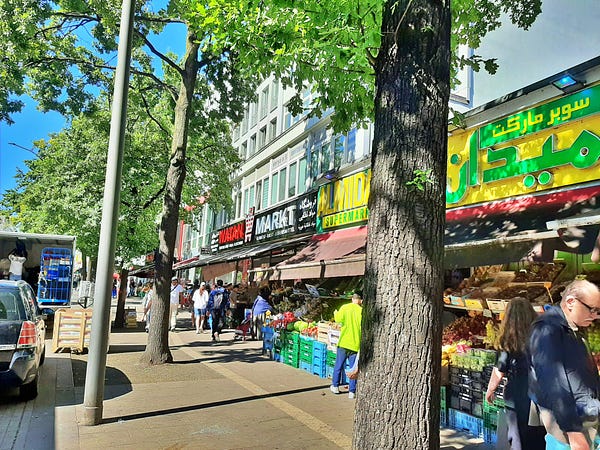
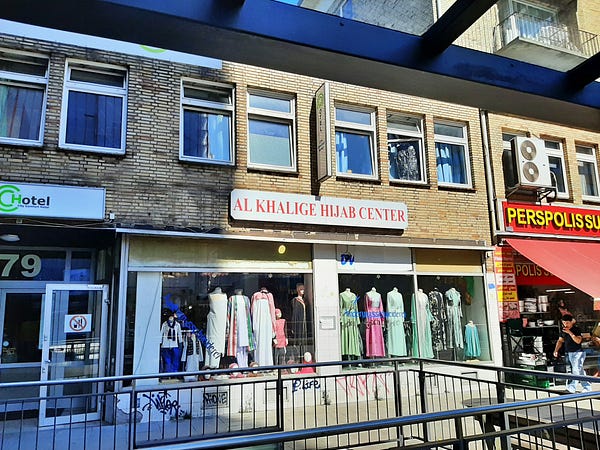
Tourist guides describe St. George as a colorful, multicultural area full of entertainment. I always find it amusing to compare such descriptions with the street’s reality.
In the phenomenal movie Falling Down with Michael Douglas, the protagonist orders a burger at a fast-food joint and asks, “Does this look like the picture on the menu?” We all know how that ended — badly.
A similar dissonance might occur when a tourist reads about St. George or Bremen (I was particularly amused by an article titled “Bremen — The Fairy Tale City”) and then faces the reality of addicts, alcoholics, and the homeless.
“All the animals come out at night.
Queens, fairies, dopers, junkies, sick, venal.
Some day a real rain will come and wash all the scum off the streets.”
I’m not sure why, but as Anthony Bourdain once observed, the kitchen often attracts society’s outcasts and misfits, psychopaths, and the mentally unstable. For me, too, the kitchen is a refuge — a place to hide from and isolate myself from the world.
The world where I feel at ease isn’t the world of tourists, middle-class neighborhoods, business districts, shiny office buildings, or fancy lunch spots. It’s the world of society’s rejects and outcasts. A place like St. George.
Many people who hit rock bottom in society started their descent due to mental illness. And I know that with my own struggles, had I been less fortunate, I could have ended up there as well.
To be clear, I’m not romanticizing social plagues like poverty, drug addiction, or violence. Hamburg Central Station and St. George, treated as a single area, are among the most dangerous places in Germany. Last year, Hamburg Central Station was the most dangerous location in the entire country.
So, if you plan to shop in St. George, stay alert. Typical tourists make easy targets. Luckily, with my subcultural appearance, I don’t look like a tourist or an easy victim. I seem more like a local, someone dealers might high-five.
If you enjoyed this article, you can treat me to a virtual coffee.
or buy something in my shop od Redbbule
Did you like this text? Do you want more similar ones? Support my blog
- Zaloguj lub zarejestruj się aby dodawać komentarze