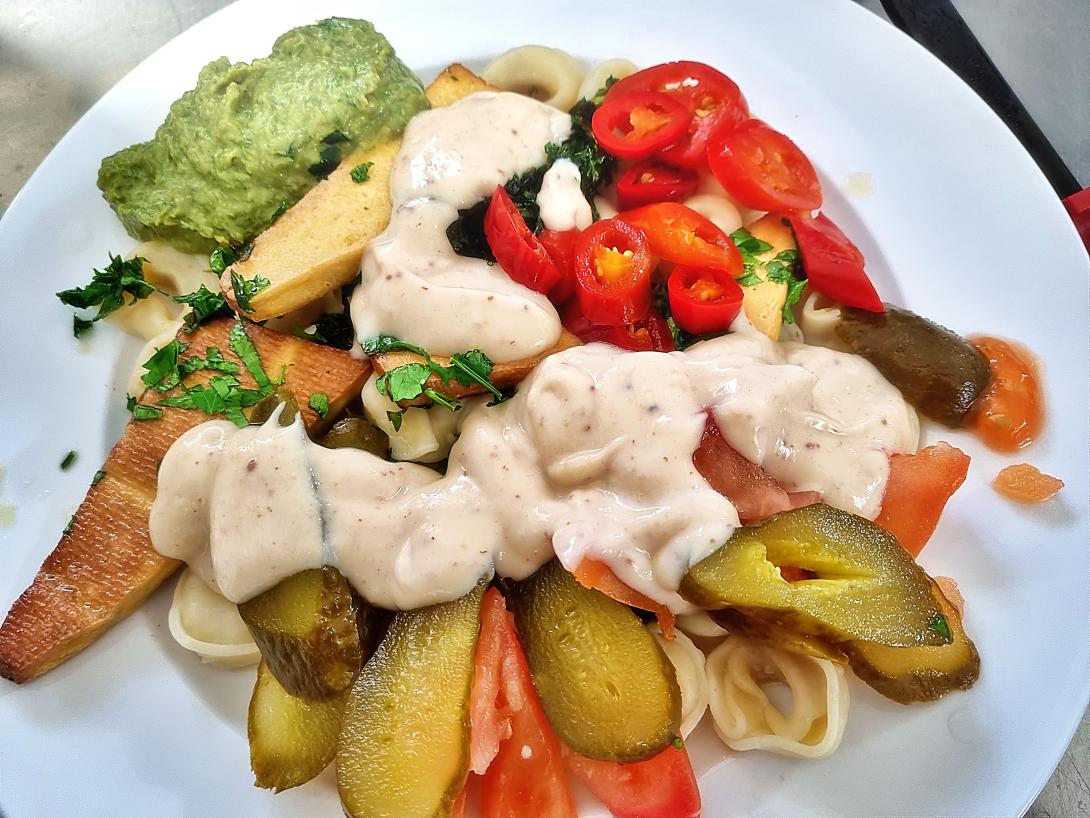
Breakfast is the most important meal of the day. However, one does not necessarily feel like cooking in the morning... or at all, really. In fact, I don't like cooking for myself unless I have a new idea for a recipe, a new taste that I want to try out. Otherwise, cooking for myself is more often a burden than a pleasure. Plus, after a week-long party where I cooked for, say, 15 people, I really don't feel like cooking. That's why I usually go to Hamburg after such a party to eat something someone else has cooked. Recently, I was at KKoki Loves Vegan and you can see these trips on Insta.
And that's why I reach for various kinds of "ready-made meals." Ready-made dishes, highly processed products, etc., don't have a very good reputation. And that's not entirely true anymore; more and more such products have good, short ingredient lists, and it's worth paying attention to that when buying them.
And to treat such a ready-made product, a ready-made dish, as one element that we enrich on the plate with lots of vegetables and whatever else we have on hand.
Recently, I've taken a liking to vegetable tortellini, a package of which lasts me two servings. They cook in 12 minutes, which is just enough time to prepare the other breakfast ingredients.
So what can we add? Protein. Vegetable tortellini is, of course, carbohydrates, fiber (great), but it definitely needs protein. Indispensable, widely available in Europe, is the Asian product tofu. I happen to have smoked tofu here.
I put the tofu on a pan with heated almond oil. That's what I have open right now, but of course, olive oil or rapeseed oil is perfectly fine. But peanut, almond, or sesame oil also have a great aroma that will enhance any dish.
At the end of frying, I added chopped parsley and lime juice. It enriches the flavor and provides iron at the same time.
Of course, it could be tempeh, seitan, cooked and sautéed legumes. Frying is not very healthy, but when frying plants, we fry them for a shorter time than meat and use unsaturated fatty acids. And frying enhances the flavor. The kitchen should be tasty first and foremost, healthy and balanced with that. There's no point in having a super-healthy and ecological dish if it's not tasty.
Add to that the vegetables. Fresh, pickled, marinated, whatever we have. For me, it was tomato, pickled cucumber, and of course, pickled jalapeno.
Yogurt sauce. For me, it's my favorite lupine yogurt with fig mustard (a revelation, very sweet, bought in the Edeca market), but any other sweet mustard, or apple cider vinegar or other flavored vinegar, a pinch of salt is just fine.
I also put on the plate a yogurt hummus with bear garlic that I made recently for veg kebab.
It's also worth adding, for example, sprouts. A sprouter is a cheap and space-saving kitchen gadget that can enrich our meals and improve our health. Did I sound like a sprouter salesman? Or a teleshopping guy?
But the point is to have lots of colors, flavors, and textures on the plate. Evolutionarily, we are shaped so that if we get different colors, flavors, and textures in one dish, we like it more. It's worth remembering when composing our meals, not just those based on ready-made meals.
A good and versatile addition, rich in nutrients (but also calories, so let's not overdo it) are all kinds of seeds, grains, nuts, roasted, stewed, boiled, fried. Cashews, walnuts, peanuts, pumpkin seeds, sunflower seeds, hemp seeds (a phenomenal source of protein). We can roast a larger amount of mixed grains and add it on the plate or add it to, for example, fried tofu in a pan.
And in this way, in fifteen (or twenty, depending on how quickly the water for tortellini boils) minutes, we have a nutritious and tasty meal.
- Zaloguj lub zarejestruj się aby dodawać komentarze